Pages

Wednesday, November 17, 2010

Who dunnit? October 1970

During the recent commemoration of fortieth anniversary of the October Crisis (1970-2010) and the death of Liberal cabinet minister Pierre Laporte, I got to wondering what really happened, way back then...

So when I learned there was a new novel, by Quebec writer Louis Hamelin, that explored the same questions I have been asking, I ran out and bought it. I haven't finished it yet, but it has already triggered a whirlwind of questions. Some of them I have been asking for a long time, and some are altogether new -- and pretty alarming, I think, to anyone who really cares about this country, the one called Canada, the one we live in and think of as 'home.'

I can see scandals looming like thunderclouds,nebulously at the moment.

The question that haunts me the most is: What if what we think happened in October 1970, when the Front de Liberation du Quebec kidnapped two men, one of whom ended up dead - is actually a lie?

How many people would be forced to look back at their most deeply held beliefs, loyalties, and actions of the past 40 years, in the light of new information that suggests we have all been duped?

How's that for an indigestible irony worthy of a Russian novel?


La Constellation du lynxLa Constellation du lynx by Louis Hamelin

My rating: 5 of 5 stars


Without a doubt, this novel has saved my life. I was 19 during the October Crisis, a passive spectator in a national drama that never quite made sense, not at the time, and not in retrospect. Louis Hamelin has changed the past by going back and, like a good journalist, resurrecting the ghosts, especially of Pierre Laporte (alias Paul Lavoie) who haunts these pages. What will keep most of the anglophones away is the thick Quebecois dialect, the multi-layered plot, the sheer length. It took me three weeks, but I made it. I never lost interest, could barely bring myself to put it down, and when I reached the end, I felt like a satisfied tourist returning from an extended crawl through the Great Pyramid.


I plan to write more about this elsewhere. (Just watch me.) It is the book of the year. It is a massive achievements not just of research and reflection, but redemption. How long will it take for the truth to penetrate the public consciousness, which has been poisoned by decades of disinformation? Is it too late for Canada to face its own colonial darkness? Can this epic even be translated into English, without bringing down another War Measures act? I have my doubts about that, too...


In the meantime, this novel should be given as a Christmas present to every Quebecer. It's as if the dead child at the end of Claude Jutra's film Mon Oncle Antoine had suddenly resurrected from his coffin and walked back into our lives. Now we can all grow up.


View all my reviews

Wednesday, October 20, 2010

Dying to read...

Making a list, checking it thrice

Books that caught my eye recently and if I don't write down the titles...

Francis Simard, Pour finir avec Octobre (translated into English by David Homel)
Peter Dubé, Subtle Bodies
Michel Thien, Ils riaient avec leur bouche
Ken McGoogan, How the Scots Invented Canada
Louis Hamelin, La Constellation du Lynx
Kathleen Winter, Annabel
Joanna Skibsrud, The Sentimentalists
Rawi Hage, Cockroach

Sunday, September 12, 2010

The Holocaust as Cliché

Sarah's KeySarah's Key by Tatiana de Rosnay

My rating: 2 of 5 stars


Parts of this are riveting -- the story of Sarah's childhood and her family's deportation from Paris to Drancy, and Auschwitz. Unfortunately, much of it is badly written Holocaust kitsch.


I was ambivalent from the beginning about the way the story alternated, almost mechanically at times, between France 1942 (told by an omniscient third-person narrator) and Paris in 2002 (in the first-person voice of an American woman who lives in France). At times I forgot this device and admired de Rosnay's ability to imagine the world of Sarah and her family, but for me, the story ended, or fell apart when the little girl arrived home at her family's abandoned apartment, found the new family living there, and discovered her brother's body in the cupboard.

This was the shock we had been dreading from the first scenes, with a sense of its inevitability, but also hope that some miracle might avert, not just tragedy, but the blank predictability of the boy's death. Surely, the writer could have found a way to keep him, and the story, alive: such as the concierge creeping into the apartment and hearing the boy's cries from his hiding place. Sarah's story might have continued, in that distant time and place, and perhaps even grown magical, managing to convey some deeper message about childhood/war/loss/survival.


It's almost insulting not just to our intelligence as readers, because we saw it coming all along, but to the craft of storytelling that this moment is presented as a climax when it's actually more of a sudden letdown -- a major bummer, and a lousy plot decision from any writing point of view. Not only does Sarah's journey fizzle when she finds the body, so does the story and most of our interest in it.

Now it's Julia's turn to become the heroine, as her narration takes over in all its breathless triviality and false naivete. Julia seems to have emerged from a box labeled Typical American Woman. Tall, blonde, with a model's looks, she works for a Paris-based magazine but has never heard of Vel' D'Hiv or Drancy, or thought too deeply about the holocaust until Sarah's story suddenly takes hold of her life. For that matter, she hasn't even given much thought to why she married her arrogant French husband, except that he's good in bed.)


Cliches about 'the French' spill from the narrator's innocent lips and pen: their coldness and hypocrisy, their grating refusal to acknowledge their role in the deportation of Jews to Auschwitz. Coming from an American -- whose country came into the war late and ever since has supported dictators, invaded countries and murdered millions in the name of "freedom" -- all this has a familiar, hollow ring -- and it obviously sells books. Sarah's Key made the New York Times Bestseller list, and has been widely praised.


A few years ago, a poll showed that French students led the world in awareness of the holocaust. France also saved more Jews, per capita, from the Nazis than any other European country. But Tatiana de Rosnay seems not to care about complexities, and does not bother to delve behind the stylized, diffident facade her Parisian characters present.


Perhaps Sarah's Key could have been a great book, but it almost seems some American editor got hold of an early draft and saved it for Hollywood by not offending Americans' taste for casting themselves in the role of rescuers of the Jews and all humanity.


View all my reviews

Saturday, July 17, 2010

Oh, the Irony

Are we irony deficient?
by Ann Diamond

What is dramatic irony and why is the world so flat without it? Why is it opposed to authorial omniscience? Because an omniscient narrator does not make mistakes, but a narrator possessed by irony is a walking disaster, a ticking time-bomb of irreconcilable opposites, propelled forward by delusory beliefs and blatant self-deception.

Few writers would dare to appear naked in public the way Madame Bovary does. When an author is in control, the reader is a spectator, reduced to complicit admiration, mere aesthetic appreciation. but when dramatic irony is present, our emotions are engaged -- horror, pity, outrage, cynicism, shock, disbelief.

Dramatic irony is the difference between a picturesque stroll and a roller-coaster to hell. Where third-person omniscience creates distance and complacency, irony stimulates emotion, revulsion and a desire to overthrow the human condition.

Why do many writers of autobiography abhor irony? Irony interferes with our urge to self-perfection. It disrupts our presumed values and exposes dark motives under the surface of pious pretence.

Dramatic irony is what leaps on stage through the ripped curtain of our badly-acted, hastily scripted lives. And when it’s allowed to work its magic, it steals the show.

Strangely, though, only beginning writers really seem comfortable the power of nudity, or the hilarious fallout that can result from an excess of honesty, poured directly onto the page.

One thing we all hate to be is unconsciously funny, or pathetically unaware of the sad truth of our lives. So authors strive to be authorial, and first novels are rewritten to eliminate dramatic irony, because it threatens to escape our control.

Some examples of ironic plot-lines we have refused to explore:

(1) the quest for "love" that devolves into jealousy, hatred, utter defeat

(2) any quest for personal greatness

(3) the truth of our own victim-hood


When we push ourselves to our limits and beyond, we become ridiculous. The last thing we really want is the shock of true recognition, the kind that unleashes complex emotions in our audience. So as authors struggle for omniscience, they rewrite some of their best scenes, strip away emotional values and replace them with socially acceptable ones.

Without irony, stories slip into staid formulae.
Truth is a powerful form of therapy that many people simply refuse to have anything to do with. And truth, these days, is often plastered with irony.

In the 20th century, anxiety took over our lives and popular fiction. In the 21st, we entered the realm of the universal lie. The mind-numbing violence on TV and in Hollywood films is really a turning away from irony – and from our inborn ability to see past surfaces. Violence is the most imprisoning plot there is. It's the triumph of fear and self-loathing, and our religions are soaked in violence.
In a world of flying shrapnel, , there’s no place for triumphant language that states only one side of the case. Words like “love” for example, have longer horns than a Papal Bull.

Blame New Agers and their positive affirmations for the omnipresence of kitsch, irony’s retarded twin. Blame the 'Christians’ who twist reality to give Armageddon a nice little Hollywood dénouement.

Irony happens in the realm of sudden, massive reversal -- of climaxes that overturn everything we thought we cherished and believed.
Starved for irony? Try this simple mantra: “I am an irony magnet.”
In no time, you’ll be covered in a sturdy chainmail coat. Which – believe me -- we’ll all be needing in the days to come.

Tuesday, June 22, 2010

Too Small to Fail


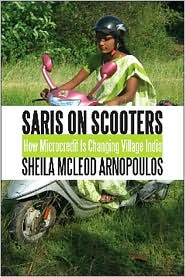
In the months just after September 11, 2001, Sheila McLeod Arnopoulos travelled to India where she began collecting stories on the microcredit phenomenon. On several visits, she spent months trekking from village to village, sleeping on reed mats, and learning about the Dalit (formerly known as 'untouchable') women who are the driving force behind the microcredit movement which is spearheading social and economic change throughout the country.

In Saris on Scooters, we find a vivid and fascinating account of the struggles and achievements of remarkable women who, though often illiterate, have overcome great obstacles in building businesses and cooperatives using small loans. The book is also entertaining, thanks to Arnopoulos' quest to understand a vast and baffling country she obviously loves. As she moves around doing interviews and gathering data, a whole, crowded world opens up which would be inaccessible to most travellers in India: the world of village women whose daily lives revolve around subsistence gardening, livestock, cottage industry, and of course family. The more she explores this world, the more fascinating and inspiring her story becomes.

Westerners are used to reports of collapsing banks, failing investment funds, and endemic corporate fraud -- but these stories are driven by the heroism of the poorest of the poor, living in a country which is only marginally affected by the high-tech revolution happening in its cities. The world of the village women is still agrarian and communal, and the women behind the self-help movement seem like human incarnations of Mother Earth. As they emerge from the shadows of a pre-industrial society, they offer inspiring solutions to some post-industrial nightmares: pollution, GMOs, social and environmental degradation.

Arnopoulos points out the inherent wisdom of these women who live at the bottom of the human totem pole. Their solidarity, spiritual strength, and apparently selfless commitment to creating a better future for their children, stand in stark contrast to the spectacle of western societies now literally drowning in oil, where war for resources is becoming a way of life.

Each chapter of Saris on Scooters stands as a lesson in how, as one Dalit 'seedkeeper' tells Arnopoulos, the most essential kinds of knowledge come directly from Mother Nature, not from books and universities. It comes down to a revolution based on rediscovering an ancient source of renewable resources and human energy which are there for all, to be shared with the whole world.

Friday, May 7, 2010

RE-READING BEAUTIFUL LOSERS, POST 9-11


For the third time in my life as an ageing child of the sixties, I am reading Beautiful Losers.

The pyrotechnics of this much-acclaimed, maniacally experimental novel obscure the shocking truths it is woven around.

Genocide
Pedophilia
A hidden holocaust
MKULTRA mind control
Nazi experiments on human beings, in particular children

Cohen peppers the novel with references to this tragic story, but uses these horrors as comic triggers. The reader zigzags between heaven and hell, as the amphetamine-gulping narrator gropes for a missing moral centre in a world that has exploded.

When we read it in the sixties, we were shocked, thrilled and titillated. But, as Bob Dylan says, "Things have changed."

Read in the light of what we know now about the classified goings-on at McGill during the years preceding the writing of this bizarre roman-a-clef, it tends to seem tragic.

Maybe there was even comedy at Auschwitz. I wouldn't be surprised there were clowns in the barracks, loved for their ability to get a laugh out of the dying and soon-to-be-dead.

Human soap turns up several times in Beautiful Losers, as well. It's one of those standards of holocaust humour, I guess.

Human soap is really the lighter side of Mengele's experiments. Almost a euphemism for crimes so unspeakable they are never discussed. Thus the truth slips into the yawning abyss of amnesia, and a whole new generation of mind-controlled patriots are preparing to follow their leaders into Armageddon.

Still -- in the light of the documents sitting in Washington, and all that has appeared on the internet and elsewhere over the last few years, as child victims recover their memories and voices and begin to publish their accounts of CIA torture, funded by our governments -- Beautiful Losers seems strangely relevant today.

Part of it is set in a Montreal mental hospital, after all, during the days when MKULTRA was running amok in that city.

Other parts are set in the past, when Jesuit missionaries ran equally amok among the Hurons and Montagnais in Quebec. The absent heroine of Beautiful Losers is Katherine Tekakwitha, a Mohawk saint, who survived the smallpox that killed off most of her tribe, and ended up dying as a result of her conversion to Catholicism.

There are references to the orphanage where the narrator, and his mentor F., were raised, and introduced to various forms of rampant abuse.

Leonard was barely thirty when he penned this epic, fuelled by amphetamines and perhaps just a trace of rage, which he disguises behind comedy.

Reading it now, it's fairly obvious that Leonard knew quite a lot about Ewen Cameron and MKULTRA and the secret experiments on children, including First Nations children, at McGill. He also knew what happened to people who talked too openly about what they knew.

But how much did he know? Perhaps Beautiful Losers was written from bits and pieces of information Cohen heard, and cobbled together into a novel. Perhaps he did not directly witness these horrors, which he recounts in a hallucinatory stream of consciousness manner -- after all, it was 1966, he had done LSD, and read The Lamp of Albion Moonlight,by Kenneth Patchen, a novel some say inspired this one

But hallucinations alone -- even very well-informed hallucinations -- don't account for the parallels between the events described in Beautiful Losers, and the real, secret goings-on in behavioural labs at the Allan Memorial Institute, hub of secret CIA experiments on various hapless mental patients, and children.

The Nazi connection, which Cohen flirts with but does not develop, is plain to anyone, and now backed up by thousands of pages of declassified CIA documents. Not that those documents mention children, of course. If they did, my generation would have grown up a lot more quickly. We would have stopped believing in fairy tales a long time ago.

There are no documents that survived past 1973, when CIA director Stansfield Turner ordered his staff to shred every piece of evidence relating to one of the ugliest research programs ever to grace the halls of learning.

But Leonard Cohen mentions them in BEAUTIFUL LOSERS. Oh, not too directly, of course, but he alludes to orphans and pedophile scientists and priests, and paints a picture of a world that, back in those days, seemed like the fantasy product of a mind wasted by drugs.

Cohen, the whistleblower, twanging his Jews' harp in the ruins of what used to be called The Free World.

Cohen the sly operative, shrewdly estimating the limits of what he could say in print. He knew if he told the simple truth, it would not be believed.

And he was right. Not ONE critic ever got the message. No one connected the obvious dots, or followed the trail of breadcrumbs that Leonard dropped for us in the woods. If they had, the trail would have led to the witch's door, and straight to the oven.

It's 40 years since Beautiful Losers was first published in 1996. And it's time for us to reread it, with a copy of John Marks' The Making of the Manchurian Candidate by our bedside, and our browsers poised to search for real, true stories of the orphans, children, First Nations children, pedophile priests, cynical politicians, and Nazi doctors... all of whom populate the pages of Beautiful Losers.

In mythic form, of course.
Is it surprising that I've tunnelled through libraries for news about victims?
Fictional victims! all the victims we ourselves do not murder of imprison..." p. 7
Still a brilliant literary diversion, this tour de force of style and showmanship is built on the bodies of the "fictional" victims whose graves Leonard graces with a book-length epitaph.

"I've poisoned the air, I've lost my erection.
Is it because I've stumbled on the truth about Canada?
City Fathers, kill me, for I have talked too much." p. 37

Recently in an interview, Cohen called Beautiful Losers a long "prayer." Strange, how religion tends to blur distinctions and wipe out memory: much like those drugs MKULTRA was giving out to all and sundry. I hope you'll go out and find an old copy, or buy the new edition, and decide for yourself.

Ann Diamond is a Montreal-based writer whose most recent book is MY COLD WAR, about growing up in the shadow of secret government experiments conducted on children.

Article Source: http://EzineArticles.com/?expert=Ann_Diamond

Thursday, May 6, 2010

EARTH AND HIGH HEAVEN


I’m curious these days about subversive military themes that weave themselves through Canadian writing, especially novels. Throughout its history, Montreal has been the scene of overt and covert military operations: think Patriote Rebellion 1837. Think October Crisis 1970. Think Oka 1990. And it goes on...
So it happens that the first Montreal-based novel I picked up to read this week was Gwethalyn Graham’s EARTH AND HIGH HEAVEN, which first appeared in 1942 to stunning acclaim. It won a Governor General's Award, topped the New York Times best seller list for 37 weeks, and was optioned by Samuel Goldwyn Mayer for the unheard of figure of $100,000 (but never made it to the silver screen).
Gwethalyn Graham moved to Montreal from Toronto, via Smith College. Set in Westmount, EARTH AND HIGH HEAVEN a sober portrait of Montreal's Anglo elite viewed by an outsider. At times there's a claustrophobic sense of being trapped inside the four walls, and conversational routines of the Drake family home. Mr. Drake has lost his fortune in the crash of 1929, and given up all hope of ever gaining it back. His only son is off fighting in Europe, while eldest daughter Erica has a job as women’s editor of the Montreal Post. The distant war forms a dramatic backdrop to a personal story of two lovers held apart by family prejudice. It's Romeo and Juliet on Mount Royal, but the struggle is not between feuding French and English. In an era of widespread anti-semitism -- the polite variety found in Canada, contrasted with the kind that is ravaging Europe -- Erica falls in love with a young Jewish lawyer named Marc Reiser, and comes face to face with her family's deep-rooted prejudices.
What makes novels interesting is often what goes in the background of them. Not just subplots, but insights and asides not pursued or developed in a conscious way -- odd facts dropped into the narrative which illuminate a time and place.
Like Anne Marie MacDonald’s AS THE CROW FLIES, the plot of EARTH AND HIGH HEAVEN is dotted with references to a world secrets, and threads a path through the repressed wilderness that is Canada. For example, there are glimpses of the nepotistic world of Montreal newspaper publishing is almost an extension of Westmount, and Erica holds her job partly due to her father’s connections.
Montreal is a divided city without hope, according to Mark, who came to Quebec from a northern Ontario lumber town where his family own a business. He finds himself unwelcome in the cozy upper class enclave where Erica and her family live their insulated lives.
While Erica battles her convention-bound parents for the right to date Marc , the real dramas going on in the outside world sometimes surface in conversation, only to be dropped because they`re insoluble.
A French-Canadian friend has heard rumours the Nazis are creating “human robots” in the conquered lands of eastern Europe. Marc, who has lost relatives in the holocaust, resents the dominance of the Catholic Church in Quebec, “responsible to no one and nothing but itself.”
Canadian politeness, bordering on censorship, drives the plot, forcing characters to address each other awkwardly as they endlessly debate the issues that seem almost quaint. The couple’s romantic decision at the end leaves much unresolved – but that’s not a bad thing. Their relationship may really be doomed, or they may overcome the social odds. Graham chooses to end the story in Montreal’s Windsor Station, at the moment when Marc catches sight of Erica, and starts to run toward her. The outcome of the war in Europe, and the progress of the undeclared silent war going on between elites in Canada, are left up in the air. The book ends on a day in the fall of 1942, with Hitler`s armies on the ascent in Russia.
War has also invaded the lives of Westmount's WASP community, even while Canada remains remote and aloof from the upheaval going on in Europe. Marc enlists in the Air Force while Erica’s brother Anthony is already overseas. Out of desperation at her family’s rejection, and in revolt against Canadian hypocrisy, Erica (28) decides, in the end, to join the women’s army corps and follow Marc to Europe -- The novel ends before they get there there – instead they become engaged, almost a plot necessity in a women’s novel written in 1942.
Nevertheless it holds our attention – both as a period piece and also a reminder of how much, and how little, Montreal has changed.